Showing posts with label Ford. Show all posts

Friday, June 10, 2011

Upcoming Model of 2013 Ford Mustang GT500 Spy Shots

Early this spring, word emerged on the Web that the 2013 GT500 could kick out as much as 620 horsepower. Shortly after we brought you the first spy shots of the new car. Today, we update the images with a new set that hints at a turbocharger replacing the supercharger under the hood. A larger, higher-capacity intercooler spotted peeking out from behind the grille is the cue for the turbo speculation. It may simply be an upgrade to the supercharged model, but it might also indicate a need for yet more charge-cooling capability brought on by twin-turbocharging. If it doesn't get a twin-turbo V-8, the next GT500 is expected to pack a 5.8-liter supercharged V-8 based on the current aluminum-block 5.4-liter engine. Either way, the new GT500 has the coming 2012 Chevrolet Camaro ZL1 squarely in its sights. If it's an improvement on the current GT500, Chevy will have a very hard time matching.

Thursday, June 2, 2011

The 2011 Ford Mustang GT

The Ford Motor Company has been nudged awake by the arrival of the Chevrolet Camaro (and to a lesser degree the Dodge Challenger). A year after the reincarnation of its old rival and but a year after the redesign of its own pony car, Ford is getting aggressive about its corner of the pony car market with the 2011 Ford Mustang GT, which introduces a 412-horsepower 5.0-liter V8, plus both a six-speed manual transmission and a six-speed automatic. The ingredients needed to make a Mustang: horsepower, horsepower, and more horsepower, plus a chrome pony, a glove box, and a cigarette lighter. Thankfully, Ford has embellished on this old-fashioned recipe with a car that handles, gets decent fuel economy when driven mildly, and doesn’t consume your driveway like the much larger and heavier Chevy Camaro and Dodge Challenger. Since the Mustang went into production 46 years ago, Ford has made steady and incremental improvements almost every year. The car has benefited, rising to the top of the muscle-car heap as others stagnated or went out of production. This year the changes are big, starting with a new four-cam, 32-valve, aluminum-constructed 5.0-liter V-8.

Tuesday, April 5, 2011

The Ford Bronco II was a compact SUV sold between 1984 and 1990

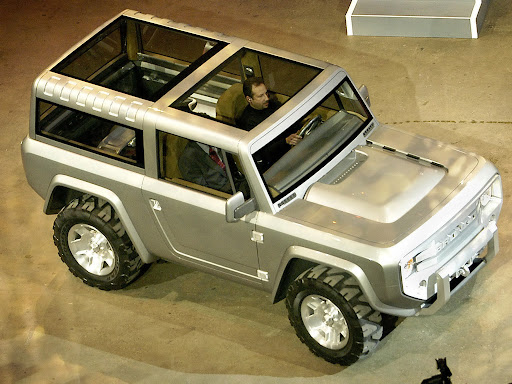
The Ford Bronco II was a compact SUV sold between 1984 and 1990. It was commissioned as a smaller complement to the full-size Bronco as well as to offer a Ford alternative to the Chevrolet S-10 Blazer, Jeep Cherokee (XJ), and Toyota 4Runner. The Bronco II was Ford's first compact SUV since the original Bronco sold from 1966 to 1977. It is mechanically and (except in detail) structurally identical to the Ford Ranger. It had a 94-inch (2,388 mm) wheelbase and was enclosed in the rear. Unlike the Bronco, the Bronco II offered four wheel drive as an option (all full-sized Broncos were four wheel drive) and did not have a removable roof.


The Ford Bronco is a sport utility vehicle

The Ford Bronco is a sport utility vehicle that was produced from 1966 through 1996, with five distinct generations. Broncos can be divided into two categories: early Broncos (1966–1977) and full-size Broncos (1978–1996). The Bronco was introduced in 1966 as a competitor to the small four-wheel-drive compact SUVs such as the Jeep CJ-5 and International Harvester Scout, and built on its own platform. A major redesign in 1978 moved the Bronco to a larger size, and it was built using a shortened Ford F-Series truck chassis to compete with the similarly adapted Chevrolet K5 Blazer.


The Edsel Villager was a station wagon produced by the former Mercury-Edsel-Lincoln

The Edsel Villager was a station wagon produced by the former Mercury-Edsel-Lincoln (M-E-L) Division of the Ford Motor Company of Dearborn, Michigan, and sold through its Edsel marque from 1958 to 1960. Like the two-door Edsel Roundup and premium Edsel Bermuda station wagons, the Villager was built on a 116 in wheelbase shared with Ford's station wagons, as well as core body stampings. The Villager and the Ranger were the only two model names that existed throughout the Edsel's three-year life span as an automobile marque. The Villager represented the lower trim level available within the Edsel brand for station wagons, but differed from the two-door Roundup by being offered in six and nine passenger styles. The Villager was available in a four-door configuration only. In terms of interior and exterior trim, the Villager had parity with the Edsel Ranger's interior and exterior appointments. Standard features included black rubber floor mats, ashtrays, cigar lighter, arm rests, chromed rear-view mirror and crank-operated rear windows. Like all other Edsel wagons, the Villager came with a two-piece tailgate.


The Edsel Ranger was an automobile produced by the former Mercury-Edsel-Lincoln Division of the Ford


The Edsel Ranger was an automobile produced by the former Mercury-Edsel-Lincoln Division of the Ford Motor Company of Dearborn, Michigan, and sold through its Edsel marque in 1958. Rangers were built on the shorter Edsel platform, shared with the Ford Fairlane as was the Pacer. In addition, both shared the Fairlane's body shell. The Ranger was the base trim option for Edsel in its first and second years as an automotive marque. Rangers were available in two-door coupes, four-door sedans, and two and four-door hardtops. The model range did not offer a convertible in 1958 or 1959, but did offer that body style in 1960. Ranger is one of two of Edsel's model nameplates re-used by Ford, Villager being the other.


The Boss 302 Mustang was a Ford Mustang high performance variant

The Boss 302 Mustang was a Ford Mustang high performance variant produced in 1969 and 1970. It was produced for the Trans Am racing series, while the Mustang Boss 429 which was produced the same years was built around a larger engine. Ford has recently revived the Boss 302 for the 2012 model year.The Camaro/Mustang rivalry had begun in 1967 with the introduction of the Camaro by Chevrolet. The Camaro was the largest threat to the lead Ford had in the "pony car" field, a niche of car manufacturing largely created by Ford with the introduction of the Mustang in mid-year 1964. Despite the lead Ford had in this field, the performance of the Mustang did not stack up to that of the Camaro. The small block and big block Chevrolet were more than a match for the 289 and 390 Fords placed in the Mustang. Ford, in an effort to burnish their "total performance" image introduced the 428 Cobra Jet in mid-year 1968, and in 1969, built one of Detroit's most interesting power plants, the Ford Boss 302 engine V8. The design was a composite engine using the "tunnel port" Windsor block and large Cleveland heads. The engine was fitted to Mustangs sold to the public to allow Ford to use the new engine to compete in the Trans-Am series.